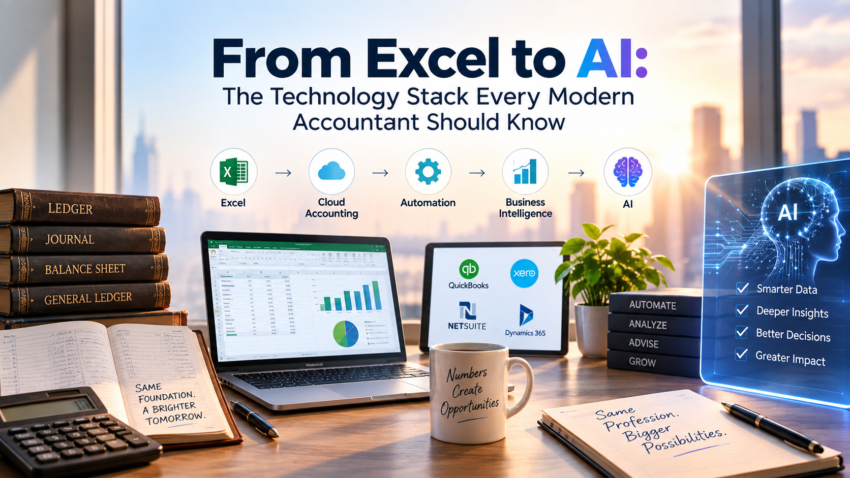
Accounting has changed dramatically. But the biggest change isn’t the technology. It’s what technology allows accountants to become.
There was a time when an accountant’s world revolved around a calculator, a ledger, and a stack of papers.
Then came Excel.
Suddenly, accountants could organize thousands of transactions, build models, analyze data, and create reports faster than ever.
Then came cloud accounting.
Books moved online. Bank feeds became connected. Reports became available in real time.
Then came automation.
Repetitive tasks that once took hours could now be completed in minutes.
And now, we have Artificial Intelligence.
But this raises an important question:
Is technology replacing accountants, or is it changing what an accountant can become?
The Accountant Has Always Adapted
Every major technology shift created the same fear.
“Will this make accountants unnecessary?”
Excel didn’t.
Cloud accounting didn’t.
Automation didn’t.
Instead, each technology removed some manual work.
That gave accountants more time to focus on analysis, judgment, and advice.
AI is following the same path.
But this time, the change is much bigger.
AI can work with large amounts of information. It can summarize documents, identify patterns, assist with research, and support complex workflows.
So the opportunity is not simply to work faster.
It is to work differently.
Step 1: Excel — The Foundation
For decades, Excel has been one of the most important tools in accounting.
It still is.
Accountants use it to:
- Analyze financial data
- Build forecasts
- Reconcile accounts
- Create financial models
- Identify trends
- Test different scenarios
But there is a new question accountants should ask:
Am I using Excel to create insight, or just to move data around?
That distinction matters.
Technology should reduce repetitive work.
It should not create more of it.
Step 2: Cloud Accounting — Connected Information
Accounting has moved far beyond desktop software.
Today, platforms such as QuickBooks Online, Xero, NetSuite, and Microsoft Dynamics connect many parts of a business.
Banking.
Invoicing.
Expenses.
Payroll.
Receivables.
Payables.
Financial reporting.
The result is more than convenience.
It creates a more connected view of the business.
And when information becomes available faster, decisions can become faster too.
Step 3: Automation — Let Technology Handle Repetition
Think about the tasks accountants perform every month.
Bank reconciliations.
Invoice processing.
Payment reminders.
Data entry.
Recurring reports.
Document collection.
Many of these tasks follow predictable patterns.
That makes them ideal for automation.
The goal isn’t simply to save a few minutes.
The bigger goal is to give accountants something much more valuable:
Time.
Time to investigate.
Time to analyze.
Time to advise.
Time to think.
Step 4: Business Intelligence — Seeing Beyond the Numbers
Accounting tells us what happened.
Business intelligence helps us see the pattern.
Tools such as Power BI can turn large amounts of financial data into clear dashboards and reports.
Instead of reviewing hundreds of transactions, management can quickly see:
- Revenue trends
- Profit margins
- Cash flow
- Customer performance
- Department costs
- Key performance indicators
The accountant’s conversation then changes.
It is no longer:
“Here is your report.”
It becomes:
“Here is what your report is telling us.”
That is where accounting becomes more valuable.
Step 5: AI — The Next Layer
AI is taking this transformation further.
It can help accountants:
- Analyze documents
- Summarize financial information
- Assist with research
- Identify unusual transactions
- Extract data
- Draft communications
- Analyze patterns
- Support forecasting
But there is one thing every accountant must remember:
AI can provide an answer.
The accountant must still understand the answer.
AI can identify an unusual expense.
But an accountant needs to ask:
Why did it happen?
AI can identify a change in revenue.
But an accountant needs to ask:
What caused it?
AI can produce a recommendation.
But an accountant needs to ask:
Does it make sense for this business?
That is where human judgment matters.
The Real Technology Stack
A modern accountant doesn’t need to master every tool.
They need to understand how the tools work together.
Excel
Analyze the data.
Cloud Accounting
Connect the financial information.
Automation
Remove repetitive work.
Business Intelligence
Visualize the story.
AI
Accelerate analysis and workflows.
Human Judgment
Understand what it all means.
That final layer is critical.
Because technology can process information.
People provide context.
The Accountant of Tomorrow
Imagine an accountant spending less time entering transactions.
Instead, they spend more time asking:
Why did profit decline?
Which customers are most profitable?
Where is cash getting stuck?
What happens if revenue falls by 10%?
Can the business afford to expand?
These are not simply accounting questions.
They are business questions.
And accountants are uniquely positioned to help answer them.
The Biggest Mistake
The biggest mistake isn’t ignoring AI.
It is believing that technology alone creates better accounting.
It doesn’t.
Bad data can produce bad analysis.
Poor processes can produce poor results.
And AI can still produce incorrect or misleading answers.
Technology needs something beside it:
Professional judgment.
That is why the future isn’t:
Humans vs. AI.
It is:
Humans + AI.
The Future of Accounting
The accountant of the past was often measured by accuracy.
The accountant of the future will need something more.
Accuracy.
Technology skills.
Analytical thinking.
Business understanding.
Communication.
Curiosity.
The technology will continue to evolve.
The tools will change.
New platforms will appear.
AI will become more capable.
But one skill will remain valuable:
The ability to look at a number and ask, “Why?”
Because finding the number is becoming easier.
Understanding the number is becoming more valuable.
A Final Thought
Excel changed accounting.
Cloud technology changed accounting.
Automation changed accounting.
Now AI is changing it again.
But perhaps the real transformation isn’t happening inside the software.
It’s happening inside the profession.
The accountant is moving from:
Recording → Reporting → Analyzing → Advising
And that is not the end of accounting.
It is the evolution of accounting.
ShreeM
Empowering the next generation of accounting professionals.