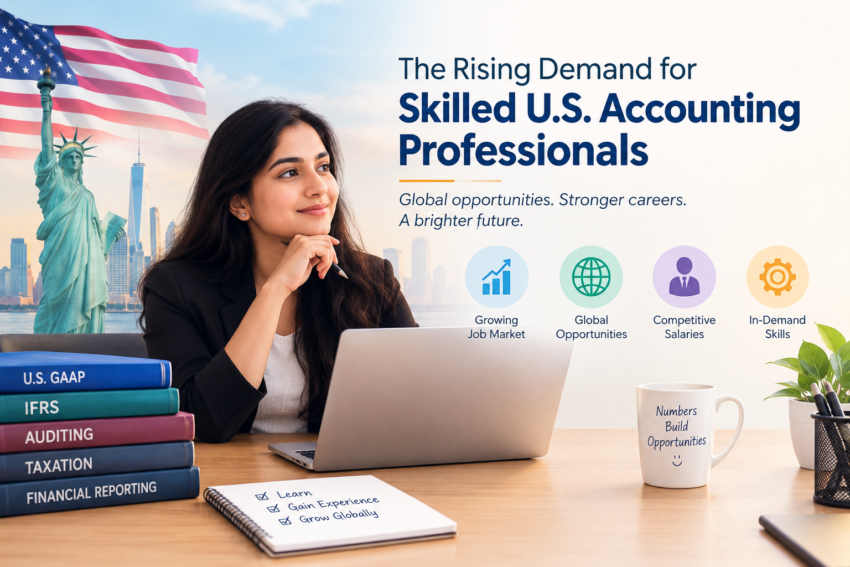
The U.S. Accounting Industry Is Growing
Accounting is changing as businesses adopt new technology and expand their operations. At the same time, many companies need skilled professionals to manage their financial records.
As a result, the demand for U.S. accounting professionals is increasing.
Businesses need accountants who can do more than enter transactions. They need people who can manage books, review financial data, reconcile accounts, and prepare accurate reports.
Moreover, many U.S. companies work with accounting teams outside the United States. This has created new career opportunities for professionals with strong U.S. accounting and bookkeeping skills.
Why Is the Demand for U.S. Accounting Professionals Growing?
Several factors are driving this demand. Let us look at some of the key reasons.
1. More Businesses Are Outsourcing Accounting
Many U.S. businesses outsource their accounting and bookkeeping work. This approach allows business owners to focus on their main operations.
At the same time, companies can work with skilled accounting teams without building a large internal department.
As a result, accounting firms and outsourcing companies need professionals who understand U.S. accounting processes.
Professionals with practical skills can work on tasks such as:
- Recording business transactions
- Managing accounts payable
- Managing accounts receivable
- Reconciling bank accounts
- Reviewing credit-card transactions
- Preparing journal entries
- Maintaining general ledgers
- Preparing financial statements
Therefore, practical U.S. accounting knowledge can open the door to several career opportunities.
2. Cloud Accounting Is Changing the Way Accountants Work
Technology has changed traditional accounting processes.
Today, many businesses use cloud-based accounting software. QuickBooks Online is one example. These platforms allow accountants and business owners to access financial information from different locations.
However, knowing how to use accounting software is not enough.
An accountant must also understand the accounting behind each transaction. For example, a professional may need to decide whether a payment is a bill payment, business expense, loan payment, transfer, or owner transaction.
Therefore, employers value professionals who can combine accounting knowledge with software skills.
3. Businesses Need Accurate Financial Records
Accurate financial records are important for every business.
Business owners use financial reports to understand income, expenses, assets, liabilities, and overall performance. For this reason, accounting professionals must maintain clean and reliable books.
Bank reconciliation is one important part of this process. Accountants compare the company’s records with bank statements and investigate differences.
Similarly, accountants may need to identify missing transactions, duplicate entries, incorrect classifications, or unmatched payments.
These tasks require attention to detail and good problem-solving skills.
What Skills Should a U.S. Accounting Professional Have?
A successful U.S. accounting professional needs both technical and practical skills.
U.S. Bookkeeping Skills
Bookkeeping is the foundation of accounting. Professionals should understand how to record and classify business transactions correctly.
They should also know how to manage bills, invoices, payments, deposits, and account balances.
QuickBooks Skills
QuickBooks is widely used by small and medium-sized businesses.
Therefore, QuickBooks training can be useful for professionals who want to work with U.S. clients.
Learners should understand more than basic data entry. They should know how to create and manage transactions, reconcile accounts, review reports, and identify errors.
U.S. Tax Knowledge
U.S. taxation is another important area.
Professionals working in U.S. accounting may need to understand basic tax concepts and common tax forms. These may include W-2, 1099, 941, and 940 forms.
A strong understanding of tax basics can help professionals support bookkeeping and tax-related work.
Payroll Knowledge
Payroll is another key accounting function.
A payroll professional may work with employee wages, payroll taxes, deductions, and payroll reports.
Therefore, basic knowledge of U.S. payroll processes can increase the range of accounting tasks a professional can handle.
Financial Reporting Skills
Accounting professionals must also understand financial statements.
The Profit and Loss Statement shows business income and expenses. The Balance Sheet shows assets, liabilities, and equity.
When professionals understand how transactions affect these reports, they can review financial information more effectively.
Why Practical U.S. Accounting Training Matters
Learning accounting theory is important. However, theory alone may not prepare someone for real accounting work.
For example, knowing the meaning of bank reconciliation is different from actually reconciling a client’s bank account.
Similarly, understanding accounts payable is different from matching vendor bills with bank payments.
Practical training helps learners understand these situations.
A job-ready U.S. accounting course should include real-world examples and practical exercises. Learners should work with accounting software, financial documents, bank transactions, bills, invoices, and financial statements.
As a result, they can build confidence before entering the workplace.
What Career Opportunities Are Available?
U.S. accounting skills can support several career paths.
Depending on their experience and skills, professionals can explore roles such as:
- U.S. Accounting Associate
- U.S. Bookkeeping Associate
- U.S. Tax Associate
- Accounts Payable Associate
- Accounts Receivable Associate
- General Ledger Accountant
- Payroll Associate
- Financial Reporting Associate
- QuickBooks Specialist
- Senior Accounting Associate
With experience, professionals can also move into roles involving client communication, accounting review, financial analysis, and team supervision.
Who Can Learn U.S. Accounting?
U.S. accounting is not limited to experienced accountants.
The field can also be suitable for:
- B.Com graduates
- Commerce students
- Finance graduates
- Accounting professionals
- Bookkeepers
- Tax professionals
- Career changers
- Professionals looking to work with U.S. clients
Most importantly, learners should be willing to practice and develop their accounting skills.
Build Job-Ready U.S. Accounting Skills
The accounting industry is becoming more digital and global. Because of this, professionals need skills that match modern workplace requirements.
A strong accounting professional combines:
Accounting Knowledge + U.S. Accounting Practices + Software Skills + Problem-Solving + Communication
Practical training can help learners develop these skills step by step.
Moreover, working with realistic accounting scenarios can help learners understand how accounting tasks are handled in actual businesses.
Start Your U.S. Accounting Career
The demand for skilled U.S. accounting professionals is creating new opportunities in accounting, bookkeeping, payroll, and tax support.
However, getting started requires more than theoretical knowledge. Professionals need practical skills and the confidence to handle real accounting tasks.
That is where the right training can make a difference.
Ready to Build Your U.S. Accounting Career?
Join our U.S. Accounting & Bookkeeping Job-Ready Professional Training Program and develop practical skills for today’s accounting industry.
Learn U.S. bookkeeping, QuickBooks, bank reconciliation, payroll fundamentals, U.S. taxation, financial reporting, journal entries, and real-world accounting workflows.
You will also get the opportunity to practice accounting tasks through practical exercises and client-based scenarios designed to build workplace confidence.
Build practical skills. Gain confidence. Become job-ready for the U.S. accounting industry.
Start your U.S. accounting career journey today.