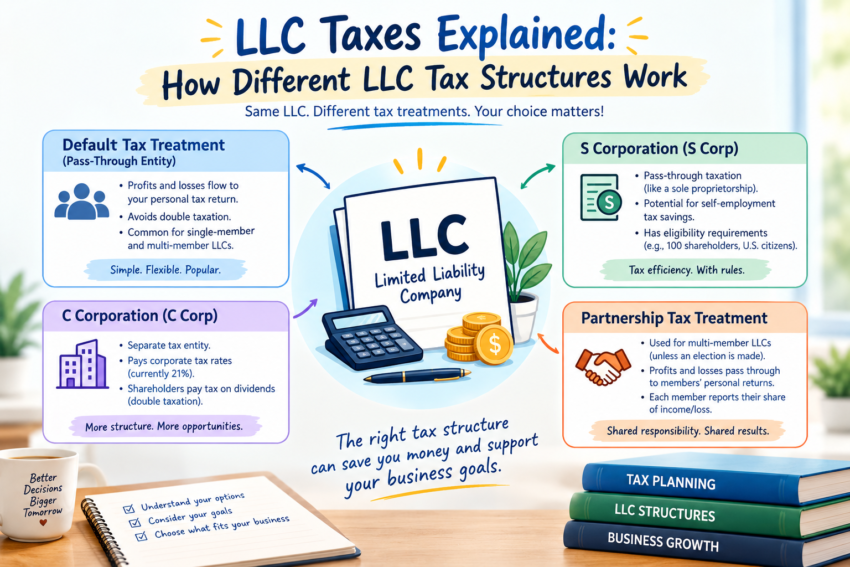
Starting a Limited Liability Company (LLC) is a popular way to establish a business in the United States. An LLC offers personal liability protection and flexibility in how the business is managed. However, one important decision business owners need to understand is how their LLC will be taxed.
The good news is that LLCs have several tax options. Depending on the number of owners, business income, and financial goals, an LLC may be taxed as a sole proprietorship, partnership, S corporation, or C corporation.
In this guide, we explain how LLC taxes work, explore the different LLC tax structures, and discuss how to choose the right option for your business.
What Is LLC Taxation?
An LLC is a business structure created under state law. For federal income tax purposes, the IRS generally treats an LLC as a pass-through entity by default, unless it elects a different tax classification.
This means that the LLC’s business income typically passes through to its owners, who report it on their individual tax returns. However, the exact tax treatment depends on the number of owners and the tax classification selected.
An LLC can generally be taxed in four main ways:
- Sole proprietorship: The default federal tax treatment for a single-member LLC.
- Partnership: The default federal tax treatment for a domestic LLC with two or more members.
- S corporation: An eligible LLC can elect S corporation tax treatment.
- C corporation: An LLC can elect to be taxed as a corporation under the applicable IRS rules.
Understanding these options can help you make informed decisions about your business finances and tax obligations.
1. Single-Member LLC: Sole Proprietorship Taxation
A single-member LLC has one owner. By default, the IRS treats it as a disregarded entity for federal income tax purposes.
Although the business remains an LLC under state law, its income and expenses are generally reported on the owner’s individual tax return.
How Does It Work?
If you operate a single-member LLC, you typically report business income and deductible expenses on Schedule C of Form 1040. The net profit becomes part of your individual income for federal income tax purposes.
You may also owe self-employment taxes on your net earnings, generally covering Social Security and Medicare.
Example
Suppose your LLC earns $100,000 in revenue and has $30,000 in deductible business expenses.
Your net business profit is $70,000. Generally, you report this profit on your individual tax return and calculate the applicable income and self-employment taxes.
Your actual tax liability will depend on your overall income, deductions, credits, and other circumstances.
Advantages
- Simple federal tax reporting.
- Fewer separate federal income tax filing requirements in many cases.
- Direct reporting of business profits and losses on the owner’s tax return.
Disadvantages
- The owner may owe self-employment tax on business earnings.
- Business profits may increase the owner’s overall taxable income.
- The owner remains responsible for meeting applicable tax and estimated payment requirements.
This structure is often suitable for freelancers, independent consultants, and small businesses with a single owner.
2. Multi-Member LLC: Partnership Taxation
A domestic LLC with two or more members is generally taxed as a partnership by default, unless it elects corporate taxation.
Under this structure, the LLC typically files Form 1065, U.S. Return of Partnership Income, and provides each member with a Schedule K-1 showing their share of the business’s tax items.
The LLC generally does not pay federal income tax on its profits at the entity level. Instead, members report their allocated shares on their individual tax returns.
How Does It Work?
Suppose two members own an LLC that earns $120,000 in profit. If they share profits equally under the applicable agreement and tax rules, each member may be allocated $60,000.
Each member generally reports their share of the LLC’s taxable income, even if the business does not distribute that amount in cash.
The actual allocation depends on the operating agreement and applicable tax rules. Special allocations may be possible, but they must meet IRS requirements.
Advantages
- Flexible arrangements for sharing profits and losses.
- Pass-through federal income tax treatment.
- Useful for businesses with multiple owners.
Disadvantages
- Annual partnership tax reporting is generally required.
- Members may owe tax on allocated profits that have not been distributed.
- Active members may owe self-employment tax on certain business income.
Partnership taxation is often a practical choice for businesses owned by two or more people who want flexible ownership and profit-sharing arrangements.
3. LLC Taxed as an S Corporation
An eligible LLC can elect to be taxed as an S corporation by filing the appropriate election with the IRS.
This option can be attractive to profitable businesses because it may reduce certain employment taxes in appropriate circumstances. However, it introduces additional payroll, compliance, and accounting responsibilities.
How Does It Work?
When an LLC elects S corporation tax treatment, an owner who works in the business generally must receive reasonable compensation as an employee.
The salary is subject to applicable payroll taxes. Remaining business profits may be distributed to shareholders and are generally not subject to self-employment tax, although the distributions remain subject to applicable tax rules.
An S corporation generally files Form 1120-S and provides shareholders with Schedule K-1.
Example
Suppose an eligible LLC generates $150,000 in business profit before owner compensation.
The owner works in the business and receives a reasonable salary based on their duties, experience, and market conditions. The business then calculates its remaining profit after salary and other expenses.
The salary is subject to payroll taxes, while qualifying pass-through income may receive different employment tax treatment.
The potential savings depend on reasonable compensation, payroll expenses, business deductions, and the owner’s overall tax situation. An S corporation election does not automatically reduce taxes.
Advantages
- Potential employment tax savings for some profitable businesses.
- Pass-through federal income tax treatment.
- Possible benefits as the business grows.
Disadvantages
- Payroll processing and additional tax filings.
- Reasonable compensation requirements for shareholder-employees.
- More administrative costs and compliance responsibilities.
- Eligibility restrictions under S corporation rules.
S corporation taxation may be worth evaluating when a business generates consistent profits that can support reasonable owner compensation and the additional costs of compliance.
4. LLC Taxed as a C Corporation
An LLC may elect to be taxed as a C corporation by filing the appropriate federal tax election.
Unlike the default pass-through options, a C corporation generally pays federal income tax on its taxable profits. If after-tax profits are later distributed to owners as dividends, those dividends may also be taxable to the recipients.
This is commonly described as double taxation.
How Does It Work?
Suppose an LLC elects C corporation taxation and earns $200,000 in taxable income.
The business generally pays federal corporate income tax on that taxable income. If it later distributes some of its after-tax earnings as dividends, shareholders may owe individual income tax on those dividends.
The final tax cost depends on the company’s deductions, applicable tax rates, dividend distributions, and shareholder circumstances.
Advantages
- Can support certain growth and investment strategies.
- May allow profits to be retained within the company.
- May provide access to corporate tax planning opportunities.
Disadvantages
- Potential taxation at both the corporate and shareholder levels.
- Additional corporate tax reporting requirements.
- More complex accounting and financial administration.
C corporation taxation may be appropriate for some businesses planning to reinvest substantial profits, raise outside investment, or pursue a particular corporate growth strategy.
LLC Tax Structures Compared
The following table summarizes the main differences between the four common federal tax treatments.
| Tax Structure | Federal Tax Treatment | Typical Filing | Key Consideration |
| Single-member LLC | Generally pass-through | Form 1040 with Schedule C | Simple reporting |
| Multi-member LLC | Generally pass-through | Form 1065 and Schedule K-1 | Multiple owners |
| LLC taxed as an S corporation | Pass-through | Form 1120-S and Schedule K-1 | Payroll and reasonable compensation |
| LLC taxed as a C corporation | Corporate taxation | Form 1120 | Potential double taxation |
These are general federal rules. State and local tax requirements may differ, and additional filings may apply.
How to Choose the Right LLC Tax Structure
Choosing the right tax structure depends on more than your business revenue. Consider the following factors before making a decision.
1. Number of Owners
If you are the only owner, the default single-member LLC classification may be sufficient. If your business has multiple owners, partnership taxation is generally the default.
2. Business Profitability
An S corporation election may be worth considering if your business earns consistent profits and potential employment tax savings outweigh the additional administrative costs.
There is no universal profit threshold at which an S corporation automatically becomes the better option.
3. Payroll and Administrative Costs
S corporation and C corporation taxation generally require more formal accounting and tax compliance than default LLC taxation. Consider the cost of payroll, bookkeeping, professional tax preparation, and required filings.
4. Growth and Investment Plans
Businesses seeking certain types of outside investment or planning to retain substantial earnings may benefit from evaluating C corporation taxation. However, the right structure depends on investor requirements and long-term plans.
5. State and Local Taxes
State income taxes, franchise taxes, annual LLC fees, and other state-specific rules can affect the overall cost of each structure.
Before making an election, compare both federal and state tax consequences.
Common LLC Tax Mistakes to Avoid
Business owners can run into tax problems when they misunderstand how their LLC is classified or how business income is reported.
Avoid these common mistakes:
- Assuming an LLC is automatically tax-free: An LLC does not eliminate income tax obligations.
- Mixing personal and business finances: Keep accurate records and separate accounts where practical.
- Ignoring estimated tax payments: You may need to make estimated federal tax payments throughout the year.
- Choosing S corporation taxation without reviewing the costs: Payroll, tax preparation, and compliance expenses can reduce potential savings.
- Forgetting state tax obligations: State filing requirements may differ from federal requirements.
- Confusing cash distributions with taxable income: Owners may owe tax on allocated business income even when they do not receive equivalent cash distributions.
Maintaining accurate records and consulting a qualified tax professional can help you avoid costly mistakes.
Frequently Asked Questions About LLC Taxes
Is an LLC taxed separately from its owner?
Not necessarily. By default, a single-member LLC is generally disregarded for federal income tax purposes, while a multi-member LLC is generally taxed as a partnership. An LLC can elect corporate tax treatment if eligible.
Does an LLC pay self-employment tax?
Owners of LLCs taxed under the default sole proprietorship or partnership rules may owe self-employment tax on applicable business earnings. S corporation shareholders generally pay payroll taxes on wages, while qualifying distributions are treated differently.
Can I change how my LLC is taxed?
Yes. An eligible LLC can generally elect a different federal tax classification by filing the appropriate IRS forms. Eligibility, filing deadlines, and effective dates depend on the election and circumstances.
Is an S corporation better than a regular LLC?
An S corporation is a tax classification, not a replacement for the LLC’s state-law business structure. It may offer tax advantages for some profitable businesses, but payroll and compliance costs must be considered.
Do LLCs pay state taxes?
They may. State and local obligations depend on where the business operates, its tax classification, and the applicable jurisdiction’s rules.
Final Thoughts
Understanding LLC taxes is an important part of managing a successful business. The default sole proprietorship and partnership classifications offer straightforward pass-through taxation, while S corporation and C corporation elections may provide advantages for certain businesses.
There is no single tax structure that works best for every LLC. The right choice depends on your ownership, profitability, payroll needs, growth plans, and state tax obligations.
Before changing your LLC’s tax classification, review the potential costs and benefits with a qualified tax professional. A well-informed decision can help you manage compliance, plan your finances, and support your business’s long-term growth.
Disclaimer: This article is for general informational purposes only and does not constitute legal, tax, or financial advice. Federal and state tax rules can change. Consult a qualified tax professional regarding your specific circumstances.