US Tax Season 2027: Key Dates, Deadlines, and Updates to Know
Introduction
The US tax season is an important time for individuals, businesses, and tax professionals across the United States. During this period, taxpayers prepare their income tax returns, gather financial documents, and claim eligible deductions and credits. They must also meet the filing and payment rules set by the Internal Revenue Service (IRS).
As US Tax Season 2027 approaches, preparing early can help taxpayers avoid missed deadlines, last-minute stress, and possible penalties. Therefore, understanding the main tax dates and filing rules is essential.
For aspiring Enrolled Agents (EAs) and tax professionals, learning these rules is equally important. In addition to meeting filing requirements, they need a strong understanding of US tax laws and procedures.
This blog covers the key US tax deadlines for 2027, common tax forms, extension rules, tax law updates, and practical preparation tips.
1. When Does US Tax Season 2027 Begin?
US Tax Season 2027 is the period when most taxpayers file their federal income tax returns for the 2026 tax year.
The IRS usually starts accepting individual tax returns in January. However, the official opening date for the 2027 filing season has not yet been confirmed.
For most individual taxpayers, the federal filing deadline is expected to be April 15, 2027. Nevertheless, taxpayers should check the IRS website for official confirmation and any changes to the deadline.
It is also important to understand the difference between the tax year and the filing season:
- Tax year 2026: The period from January 1 to December 31, 2026, for most calendar-year taxpayers.
- Filing season 2027: The period when taxpayers submit returns reporting their 2026 income.
Understanding this difference helps taxpayers organize their records and prepare the correct tax return.
2. Important US Tax Deadlines for 2027
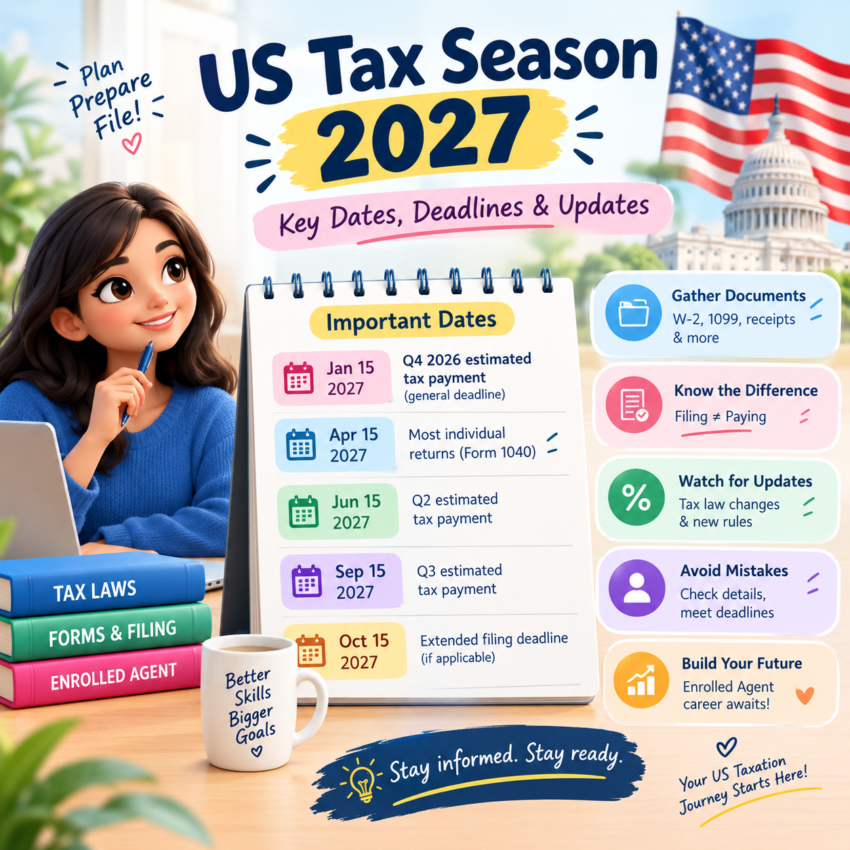
Keeping track of the 2027 US tax deadlines can help taxpayers avoid unnecessary penalties and interest. The following dates are useful for planning, although the final IRS calendar should always be checked.
| Date | Important tax event |
|---|---|
| January 15, 2027 | General deadline for fourth-quarter 2026 estimated tax payments, subject to exceptions |
| January 2027 | Expected start of the federal individual tax filing season |
| March 15, 2027 | Generally, the deadline for 2026 calendar-year partnership and S corporation returns |
| April 15, 2027 | Expected deadline for most individual federal income tax returns |
| April 15, 2027 | Generally, the deadline for first-quarter 2027 estimated tax payments |
| June 15, 2027 | Generally, the deadline for second-quarter 2027 estimated tax payments |
| September 15, 2027 | Generally, the deadline for third-quarter 2027 estimated tax payments |
| October 15, 2027 | Expected extended filing deadline for eligible individuals who requested an extension on time |
Important: These dates are based on standard federal tax calendar rules and are provided for planning purposes. Actual deadlines may change because of weekends, legal holidays, disaster relief, special circumstances, or changes in tax law.
Business filing dates may also vary depending on the type of entity and its tax year.
3. Who Needs to File a US Tax Return?
The requirement to file a federal income tax return depends on several factors. These include income, filing status, age, dependent status, and the type of income received.
For example, the following taxpayers may need to file a return:
- Employees who receive wages reported on Form W-2.
- Self-employed individuals and independent contractors.
- Freelancers and gig workers.
- Business owners and eligible owners of pass-through entities.
- Investors who receive taxable investment income.
- Individuals who meet the filing rules for other types of income.
In some cases, filing a return may also help taxpayers receive money back from the IRS. For instance, they may qualify for a refundable tax credit or a refund of federal income tax withheld from their pay.
However, filing requirements differ from one taxpayer to another. Therefore, taxpayers should review the IRS rules that apply to their own situation instead of relying on a single income limit.
4. Essential Documents to Prepare Before Filing
Gathering documents early can make the tax filing process much easier. It also helps taxpayers reduce mistakes and avoid delays.
Here are some common documents to prepare before filing:
- Form W-2: Shows wages and certain taxes withheld by an employer.
- Forms 1099: Report different types of income, such as interest, dividends, and nonemployee compensation.
- Form 1098: Reports certain types of interest or other information, depending on the form.
- Form 1099-INT: Reports interest income.
- Form 1099-DIV: Reports dividends and certain distributions.
- Form 1099-NEC: Generally reports nonemployee compensation.
- Receipts and expense records: May support eligible business expenses or deductions.
- Previous year’s tax return: Helps taxpayers review personal details, carryovers, and past tax information.
- Estimated tax payment records: Help taxpayers report qualifying payments correctly.
Not everyone needs every document listed above. Instead, the required records depend on income sources, deductions, credits, and other personal circumstances.
As a result, reviewing financial records before starting a return can save time and make tax preparation more accurate.
5. What Is the Difference Between Filing and Paying Taxes?
Filing a tax return and paying taxes are two separate responsibilities. Many taxpayers mistakenly believe that an extension gives them more time to complete both tasks.
Filing taxes means sending the required tax forms and information to the IRS.
Paying taxes means paying the amount owed by the applicable payment deadline.
Eligible individual taxpayers can generally request an automatic six-month extension to file their federal income tax return. They can do this by submitting Form 4868 on time or using an eligible IRS extension method.
For the 2026 individual tax return, the extended filing deadline is expected to be October 15, 2027, subject to the standard rules and any applicable adjustments.
However, an extension to file does not extend the payment deadline. Taxpayers should generally estimate their tax bill and pay any amount due by the original deadline. Doing so can help reduce possible penalties and interest.
6. Estimated Tax Payments: Important Dates to Remember
Estimated tax payments are important for people who do not have enough tax withheld from their income throughout the year. These payments commonly apply to self-employed individuals, independent contractors, investors, and certain other taxpayers.
For many calendar-year individual taxpayers, the standard estimated tax payment dates for 2027 are:
- April 15, 2027
- June 15, 2027
- September 15, 2027
- January 18, 2028, for the fourth installment covering 2027 income, subject to confirmation of the applicable calendar rules
The fourth payment date should be checked against the final IRS calendar and the rules that apply to the taxpayer.
Estimated tax requirements depend on income, tax withholding, credits, and other factors. Consequently, some taxpayers may not need to make quarterly payments, while others could face an underpayment penalty if they pay too little during the year.
To understand their responsibilities, taxpayers can review IRS Form 1040-ES and the official IRS estimated tax guidance.
7. Tax Law Changes to Watch in 2027
Tax laws and reporting rules can change each year. For this reason, taxpayers should avoid relying on outdated tax brackets, deduction amounts, credit limits, or eligibility rules.
Before preparing a 2026 federal income tax return during the 2027 filing season, review the following areas:
- Federal income tax brackets for tax year 2026.
- Standard deduction amounts and itemized deduction rules.
- Child-related tax credits and other available credits.
- Retirement contribution limits and related tax rules.
- Business deductions and reporting requirements.
- Tax rules for self-employed individuals and independent contractors.
- New IRS forms, instructions, and official guidance.
The rules that apply depend on the tax year being reported. For example, a change affecting income earned in 2026 may affect a return filed in 2027.
For tax professionals: Always review the latest IRS publications, official form instructions, and applicable legislation before advising clients or completing a return. In addition, remember that a proposed tax change is not the same as an enacted law. Check whether a change has taken effect and whether it applies to the taxpayer.
8. Common Tax Filing Mistakes to Avoid
Simple mistakes can lead to delays, incorrect refunds, or possible penalties. Fortunately, taxpayers can reduce these risks by checking their returns carefully before submitting them.
Common mistakes include:
- Missing a filing or payment deadline.
- Reporting income incorrectly or leaving out taxable income.
- Entering an incorrect Social Security number or other personal details.
- Claiming deductions or credits without meeting the eligibility rules.
- Forgetting estimated tax payments or eligible tax withholding.
- Assuming a filing extension also extends the payment deadline.
- Using outdated tax forms or information from the wrong tax year.
- Failing to keep supporting documents.
Tax professionals must also follow the rules for due diligence, recordkeeping, data security, and professional conduct. Therefore, careful preparation and a final review are important for every return.
9. How Enrolled Agents Can Prepare for Tax Season 2027
An Enrolled Agent is a federally authorized tax professional who can represent taxpayers before the IRS.
For current EAs and aspiring tax professionals, tax season provides an opportunity to apply tax knowledge, understand updated rules, and improve tax preparation skills.
Here are some practical ways to prepare:
- Review individual income tax concepts and recent federal tax updates.
- Learn how to use common forms, including Forms 1040, W-2, and 1099.
- Practice identifying income, adjustments, deductions, and tax credits.
- Review filing statuses and the rules for claiming dependents.
- Understand estimated tax payments and filing extensions.
- Study IRS notices, taxpayer representation, and professional ethics.
- Practice preparing sample returns using the correct tax-year rules.
- Follow IRS publications and official guidance for updates.
In addition, students preparing for the IRS Special Enrollment Examination (SEE) can use these topics to build a strong foundation in US taxation.
However, the SEE is a separate professional credentialing examination. Therefore, candidates should check the official exam syllabus and schedule independently of the annual tax filing calendar.
10. Final Tax Season Preparation Checklist
A simple checklist can help taxpayers stay organized throughout US Tax Season 2027.
Before filing your federal income tax return, make sure you:
- Gather income statements and supporting documents.
- Confirm your personal information and filing status.
- Review deductions and credits for eligibility.
- Check estimated tax payments and tax withholding.
- Confirm the applicable federal filing and payment deadlines.
- Review the completed return for errors.
- Keep a copy of the filed return and supporting records.
- Check your filing confirmation and refund status, where applicable.
By starting early and following these steps, taxpayers can make the filing process more organized and reduce avoidable errors.
Conclusion
US Tax Season 2027 is an important period for taxpayers and tax professionals preparing federal income tax returns for 2026. Understanding filing deadlines, payment rules, extension requirements, and tax law changes can make the process easier and more manageable.
For aspiring Enrolled Agents, learning these concepts is also a valuable step toward building a career in US taxation. By studying tax forms, practicing return preparation, and following official IRS guidance, future tax professionals can develop the skills needed to support accurate tax reporting.
Want to build your career in US taxation? Explore professional tax training, strengthen your knowledge of federal tax rules, and prepare for the next step in your Enrolled Agent journey.
Disclaimer: This article is for general educational purposes only and does not constitute tax, legal, or financial advice. Tax rules and deadlines may change. Always check official IRS resources to confirm the applicable dates and requirements before taking action.