Running a small business comes with many responsibilities, and managing taxes is one of the most important. Whether you operate a sole proprietorship, LLC, or S Corporation, having a proper tax planning strategy can help you manage expenses, improve cash flow, avoid costly mistakes, and keep more of your hard-earned business income.
For small business owners, tax planning should not be something that happens only during tax season. A proactive approach throughout the year can help you identify tax-saving opportunities, stay compliant with IRS regulations, and make better financial decisions.
If you own an S Corporation or are considering electing S Corp status for your business, understanding how business taxes work is especially important.
In this guide, we will explore essential small business and S Corp tax planning strategies for 2026, including tax deductions, reasonable shareholder compensation, retirement contributions, payroll compliance, and year-end tax planning opportunities.
1. Why Tax Planning Matters for Small Businesses
Tax planning is an essential part of running a financially healthy business. Without a proper strategy, business owners may miss eligible deductions, underestimate tax payments, or face unexpected tax liabilities.
Effective tax planning helps you:
- Reduce taxable business income through legitimate deductions.
- Manage federal and state tax obligations.
- Improve business cash flow.
- Prepare for quarterly estimated tax payments.
- Make informed decisions about business structure.
- Identify retirement and employee benefit opportunities.
- Avoid penalties and unnecessary compliance issues.
Rather than waiting until the end of the year, business owners should review their financial records regularly and work with a qualified tax professional to identify opportunities throughout the year.
2. Understanding S Corporation Taxation
An S Corporation is a tax classification available to eligible corporations and certain LLCs that elect S Corporation tax treatment.
Unlike a traditional C Corporation, an S Corporation generally operates as a pass-through entity for federal income tax purposes. This means the business’s income, losses, deductions, and credits generally pass through to shareholders and are reported on their individual tax returns.
How Does S Corp Taxation Work?
An S Corporation generally files Form 1120-S annually to report its business activity.
Shareholders receive Schedule K-1, which reports their share of the company’s taxable income and other tax items.
One of the major features of an S Corporation is that eligible shareholders who work in the business must generally receive reasonable compensation for the services they provide.
The remaining eligible business profits may be distributed to shareholders according to applicable ownership and distribution rules.
S Corp vs. LLC vs. Sole Proprietorship
Choosing the right business structure can have a significant impact on your tax obligations.
- Sole Proprietorship: Business income is generally reported on the owner’s individual tax return, and net business earnings are generally subject to self-employment tax.
- LLC: An LLC is a legal business structure. Its federal tax treatment depends on the number of owners and any tax elections made.
- S Corporation: An eligible LLC or corporation can elect S Corporation taxation. Working shareholders generally receive wages subject to payroll taxes, while qualifying shareholder distributions are generally not subject to Social Security and Medicare taxes.
An S Corporation may provide tax advantages in certain situations, but additional payroll, accounting, and compliance costs should also be considered.
3. Top S Corp Tax Planning Strategies for 2026
Business owners should understand the following strategies to make informed tax decisions.
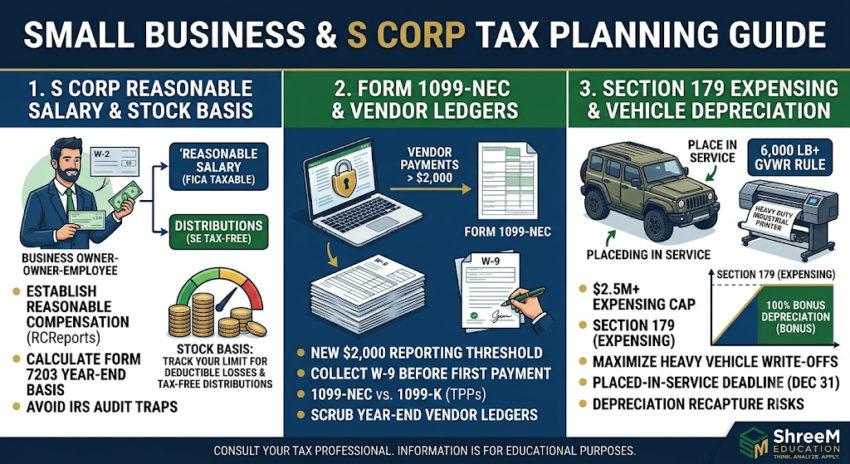
Strategy 1: Pay Yourself a Reasonable Salary
One of the most important S Corp tax planning considerations is shareholder-employee compensation.
If you actively work in your S Corporation, the IRS generally requires you to receive reasonable compensation for the services you perform before taking non-wage distributions.
Your salary should reflect factors such as:
- Your responsibilities and job duties.
- Your professional experience and qualifications.
- Time spent working in the business.
- Compensation paid for similar work in your industry.
- The company’s financial circumstances.
Paying yourself an artificially low salary to minimize payroll taxes can create IRS compliance risks.
A reasonable compensation strategy helps balance payroll tax obligations with legitimate shareholder distributions.
Strategy 2: Maximize Eligible Business Tax Deductions
Business deductions can reduce taxable income when expenses are ordinary, necessary, properly documented, and otherwise deductible under applicable tax rules.
Common business expenses may include:
- Office rent and utilities.
- Business insurance.
- Professional and legal fees.
- Accounting and bookkeeping services.
- Advertising and marketing.
- Business software and subscriptions.
- Employee wages and benefits.
- Business travel expenses.
- Eligible business meals.
- Office supplies and equipment.
Maintain receipts, invoices, bank statements, and other supporting documentation to substantiate deductions.
Remember that personal expenses cannot simply be classified as business expenses.
Strategy 3: Explore Retirement Contribution Opportunities
Retirement planning can be an effective component of small business tax planning.
Depending on eligibility and plan rules, business owners may consider:
- Solo 401(k) plans.
- SEP IRAs.
- SIMPLE IRAs.
- Traditional 401(k) plans.
For S Corporation shareholders, retirement plan contributions are generally based on eligible W-2 compensation rather than shareholder distributions.
Contribution limits and eligibility requirements vary by plan and tax year. Review the applicable 2026 limits and deadlines before making contributions.
Strategy 4: Review Health Insurance Deduction Opportunities
Eligible S Corporation shareholders who own more than 2% of the company may qualify for special federal tax treatment of health insurance premiums paid or reimbursed by the corporation.
Generally, qualifying premiums must be properly handled through the corporation’s payroll and reporting process.
Eligible shareholders may be able to claim an above-the-line self-employed health insurance deduction on their individual tax return, subject to applicable requirements and limitations.
Proper documentation and payroll reporting are important to avoid mistakes.
Strategy 5: Consider Section 179 and Depreciation Deductions
If your business needs equipment, machinery, computers, furniture, or other qualifying assets, depreciation planning may help reduce taxable income.
Two important tax provisions include:
- Section 179 Deduction: May allow businesses to deduct the cost of qualifying property in the year it is placed in service, subject to applicable limits and requirements.
- Bonus Depreciation: May allow businesses to deduct a percentage of the cost of eligible property in the year it is placed in service.
The timing of purchases, business use, taxable income limitations, and current tax legislation can affect the deduction available.
Do not purchase equipment solely for a tax deduction. Make sure the purchase supports your business needs and cash flow.
Strategy 6: Evaluate the Qualified Business Income (QBI) Deduction
Eligible business owners may qualify for the Qualified Business Income deduction under Section 199A.
The deduction may allow eligible taxpayers to deduct up to 20% of qualified business income, subject to applicable limitations.
Eligibility may depend on:
- Taxable income.
- Business classification.
- W-2 wages.
- Qualified property.
- Specified service trade or business rules.
S Corporation shareholders may potentially qualify for the deduction on eligible pass-through income, but W-2 wages paid by the S Corporation are not themselves qualified business income.
Consult a tax professional to determine whether your business qualifies under the 2026 rules.
4. Common Small Business Tax Deductions You Should Know
Understanding deductible expenses can help business owners maintain accurate financial records and avoid overlooking legitimate tax benefits.
Here are several common categories to review:
| Expense Category | Potential Tax Treatment |
| Home office | Deductible if applicable business-use requirements are met |
| Business mileage | Eligible business vehicle expenses may be deductible |
| Office supplies | Generally deductible business expenses |
| Advertising | Generally deductible business expenses |
| Business insurance | Generally deductible if business-related |
| Professional services | Generally deductible business expenses |
| Business travel | Qualifying business travel expenses may be deductible |
| Employee wages | Generally deductible compensation expenses |
| Business meals | Generally subject to applicable deduction limitations |
| Equipment | May qualify for depreciation or Section 179 |
Keep accurate records and separate business and personal transactions.
For vehicle expenses, maintain a mileage log or other appropriate documentation. For meals and travel, record the business purpose, date, location, and relevant participants.
5. S Corp Payroll and Compliance Requirements
Operating an S Corporation involves additional administrative and tax responsibilities.
Business owners should pay close attention to payroll, tax filings, and corporate records.
Important S Corp Tax Forms
Some commonly required federal tax forms include:
- Form 1120-S: Annual U.S. Income Tax Return for an S Corporation.
- Schedule K-1: Reports each shareholder’s share of income, deductions, and other tax items.
- Form W-2: Reports employee wages and withholding.
- Form 941: Reports federal income tax withholding and Social Security and Medicare taxes for applicable employers.
- Form 940: Reports federal unemployment tax, when applicable.
- Form 1040: Individual federal income tax return for shareholders.
Additional forms and state filings may apply depending on your business activities and circumstances.
Stay Current With Payroll Taxes
S Corporations with employees must comply with applicable payroll tax rules.
This includes:
- Withholding required federal income taxes.
- Paying employer and employee Social Security and Medicare taxes.
- Depositing payroll taxes on time.
- Filing required payroll tax returns.
- Issuing accurate W-2 forms.
- Maintaining payroll records.
Late deposits and incorrect payroll reporting can result in penalties and interest.
6. Quarterly Estimated Tax Payments
Small business owners and S Corporation shareholders may need to make estimated tax payments throughout the year.
S Corporations generally do not pay federal income tax on ordinary pass-through income at the entity level. However, shareholders may owe individual income taxes on their allocated business income, even if the company does not distribute all of its profits.
Estimated tax payments may be necessary to cover:
- Federal income tax.
- Self-employment tax, where applicable.
- Other individual tax liabilities.
- State income taxes.
Shareholders should review their expected income, withholding, deductions, and tax credits throughout the year to avoid underpayment penalties.
7. Year-End Tax Planning Checklist for 2026
Year-end planning gives business owners an opportunity to review their financial position before closing the books.
Consider completing the following checklist before December 31, 2026.
- Review total business income and expenses.
- Reconcile business bank and credit card accounts.
- Verify shareholder compensation is reasonable and properly documented.
- Review payroll tax deposits and filings.
- Evaluate eligible equipment purchases.
- Review depreciation opportunities.
- Check retirement plan contribution deadlines.
- Verify health insurance reporting for eligible shareholders.
- Review outstanding invoices and accounts receivable.
- Confirm business mileage and travel documentation.
- Review estimated tax payments.
- Evaluate potential S Corporation election opportunities for the next tax year.
- Schedule a year-end tax planning meeting with your CPA or tax advisor.
Some tax elections and retirement contributions have deadlines that differ from December 31, so plan ahead rather than waiting until the final week of the year.
8. Common S Corp Tax Planning Mistakes to Avoid
Even profitable businesses can experience tax problems because of avoidable mistakes.
Here are some common issues S Corp owners should watch for.
1. Paying Yourself an Unreasonably Low Salary
Shareholders who perform services for their S Corporation must generally receive reasonable compensation. Taking distributions without appropriate wages can create tax problems.
2. Mixing Personal and Business Expenses
Using business accounts for personal expenses can complicate bookkeeping and create tax reporting issues.
Maintain separate business and personal financial accounts.
3. Missing Payroll Tax Deadlines
Late payroll tax deposits and filings can lead to penalties and interest.
Use reliable payroll software or a qualified payroll provider.
4. Ignoring Estimated Tax Payments
Shareholders may owe taxes on pass-through income even when they have not received equivalent cash distributions.
Review your tax position regularly.
5. Poor Recordkeeping
Missing receipts, inaccurate mileage records, and incomplete financial statements can make it difficult to support deductions.
Maintain organized digital and physical records.
6. Waiting Until Tax Season to Plan
Waiting until the tax return is due may limit your ability to implement certain tax planning strategies.
Schedule periodic tax reviews throughout the year.
9. Should Your Small Business Elect S Corporation Tax Status?
An S Corporation election may be beneficial for certain profitable small businesses, but it is not the right choice for every business.
Before making an election, consider the following factors:
- Annual business profit.
- Reasonable shareholder salary requirements.
- Potential payroll tax savings.
- Payroll and accounting costs.
- State-level S Corporation taxes and fees.
- Ownership and shareholder eligibility requirements.
- Corporate recordkeeping responsibilities.
For eligible businesses, S Corporation taxation may offer opportunities to reduce employment taxes on qualifying distributions compared with sole proprietorship or partnership treatment.
However, the potential savings should be compared with additional administrative costs and compliance obligations.
A CPA or qualified tax advisor can help calculate whether an S Corporation election makes financial sense for your business.
10. Frequently Asked Questions About Small Business and S Corp Tax Planning
How much can an S Corporation save in taxes?
Tax savings depend on business profitability, reasonable shareholder compensation, ownership structure, applicable payroll taxes, state taxes, and administrative costs.
There is no guaranteed amount of tax savings. A business-specific calculation is necessary.
How much should an S Corp owner pay themselves?
There is no universal salary amount. The IRS expects reasonable compensation based on the actual services performed, industry standards, experience, responsibilities, and other relevant factors.
Can an S Corporation deduct health insurance?
Eligible S Corporations may deduct qualifying health insurance premiums paid on behalf of employees and properly handle premiums for more-than-2% shareholder-employees under special reporting rules.
Eligible shareholders may also qualify for an individual self-employed health insurance deduction, subject to applicable limitations.
What expenses can an S Corporation write off?
Common deductible expenses include rent, employee wages, insurance, advertising, professional fees, software, supplies, and qualifying travel and vehicle expenses.
Expenses must meet applicable IRS requirements.
Is an S Corporation better than an LLC?
An LLC and an S Corporation are not mutually exclusive business structures. An eligible LLC can elect S Corporation tax treatment.
The best choice depends on profitability, ownership, payroll costs, state requirements, and long-term business goals.
When should a business elect S Corporation status?
Businesses should evaluate the election before the beginning of the tax year in which they want S Corporation treatment.
Form 2553 generally must be filed no later than two months and 15 days after the beginning of the tax year the election is intended to take effect, subject to applicable rules and late-election relief.
Conclusion: Make Tax Planning a Priority for Your Small Business in 2026
Successful small business tax planning is about more than filing an accurate tax return. It involves making informed financial decisions throughout the year, taking advantage of legitimate deductions, managing payroll obligations, and preparing for future tax liabilities.
For S Corporation owners, understanding reasonable compensation, shareholder distributions, retirement contributions, depreciation, and compliance requirements can make a meaningful difference in managing business finances.
Whether you are starting a new business, operating an established LLC, or managing an S Corporation, having a proactive tax strategy can help you make better decisions and build a stronger financial foundation.
Don’t wait until tax season to start planning. Review your financial records regularly and work with an experienced tax professional to develop a tax strategy that aligns with your business goals.
Ready to Take Control of Your Business Taxes?
Every business has unique tax planning opportunities. Get professional guidance to evaluate your business structure, review potential deductions, manage S Corporation payroll, and develop a proactive tax strategy for 2026.