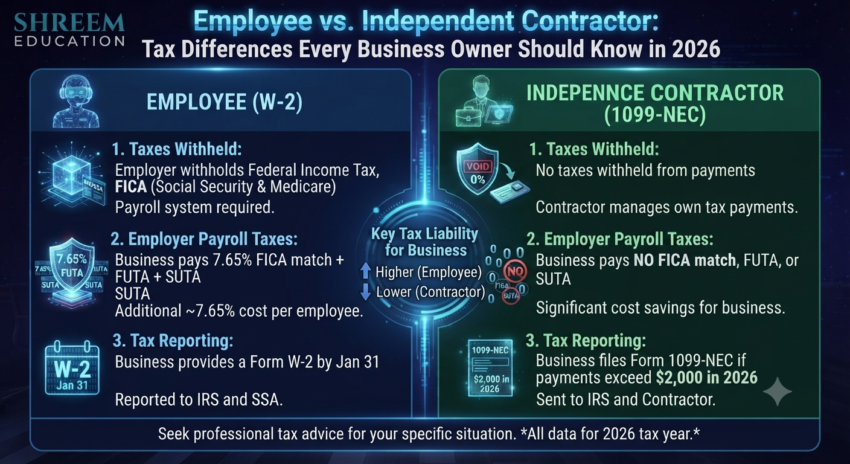
Hiring the right people is an important part of running a successful business. However, before bringing someone onto your team, you need to understand whether they should be classified as an employee or an independent contractor.
The difference between an employee and an independent contractor goes beyond job responsibilities. It also affects payroll taxes, tax reporting, business expenses, and legal responsibilities.
Many US business owners choose independent contractors because they offer flexibility and may reduce certain employment-related costs. However, incorrectly classifying a worker can lead to IRS penalties, back taxes, and other compliance issues.
So, what is the difference between an employee and an independent contractor? And how does each classification affect your business taxes?
In this guide, we explain the key differences, tax responsibilities, IRS classification rules, and important considerations for business owners in 2026.
What Is an Employee?
An employee is an individual who performs services for a business under an employment relationship.
Generally, the employer has the right to direct and control how the employee performs their work, including aspects of the work process and schedule.
Employees usually receive regular wages or salaries and may qualify for benefits such as health insurance, paid time off, and retirement plans.
Tax Responsibilities for Employees
Employees have several tax-related responsibilities:
- Pay federal income tax based on their taxable income.
- Pay their share of Social Security and Medicare taxes.
- Complete Form W-4 to provide withholding information to their employer.
- Report employment income on their annual individual tax return.
- Review Form W-2 received from their employer.
Employers also have responsibilities for withholding, reporting, and paying applicable employment taxes.
What Is an Independent Contractor?
An independent contractor is a self-employed individual or business that provides services to clients under a business relationship rather than an employment relationship.
Independent contractors generally have more control over how they complete their work. They may work with multiple clients, negotiate payment terms, and decide how to organize their services.
Examples include:
- Freelance graphic designers.
- Independent consultants.
- Marketing specialists.
- Web developers.
- Professional photographers.
- Certain construction contractors.
Tax Responsibilities for Independent Contractors
Independent contractors generally manage their own business taxes.
Their responsibilities may include:
- Reporting business income on their tax returns.
- Paying applicable self-employment taxes.
- Making estimated tax payments when required.
- Tracking deductible business expenses.
- Maintaining accurate financial records.
- Filing applicable federal and state tax forms.
Unlike employees, independent contractors generally do not have an employer withholding federal income and payroll taxes from their payments.
Employee vs. Independent Contractor: Key Tax Differences
Understanding the tax differences can help business owners choose the correct worker classification and avoid compliance problems.
Here is a comparison:
| Tax Category | Employee | Independent Contractor |
| Tax status | Employee | Self-employed |
| Income reporting | Form W-2 | Generally Form 1099-NEC when reporting is required |
| Federal income tax withholding | Generally withheld by employer | Generally paid by contractor |
| Social Security and Medicare | Shared employer and employee responsibility | Generally paid through self-employment tax |
| Employer payroll taxes | Generally applicable | Generally not applicable to payments for properly classified contractor services |
| Business expenses | Limited employee deductions under federal law | Eligible business expenses may be deductible |
| Estimated tax payments | May be needed depending on withholding and other income | Generally required when applicable |
| Employee benefits | May be eligible | Generally not entitled to employee benefits |
The actual tax treatment depends on the worker’s circumstances and applicable tax rules.
1. Differences in Payroll Taxes
One of the biggest differences between employees and independent contractors is how payroll taxes are handled.
Employee Payroll Taxes
When a business hires an employee, it generally must:
- Withhold federal income taxes from wages.
- Withhold the employee’s share of Social Security and Medicare taxes.
- Pay the employer’s share of Social Security and Medicare taxes.
- Deposit employment taxes according to the applicable schedule.
- File required payroll tax returns.
For 2026, the standard Social Security tax rate is 6.2% for both the employer and employee, subject to the annual wage base limit.
The standard Medicare tax rate is 1.45% for both the employer and employee. Additional Medicare Tax may also apply to certain employees.
Independent Contractor Taxes
Independent contractors generally pay self-employment tax on their net earnings from self-employment, subject to applicable rules and thresholds.
The self-employment tax rate is generally 15.3%, consisting of:
- 12.4% for Social Security.
- 2.9% for Medicare.
Unlike employees, independent contractors generally pay both portions through self-employment tax.
They may also need to make quarterly estimated tax payments to cover federal income and self-employment taxes.
2. Differences in Tax Forms: W-2 vs. 1099-NEC
Tax forms are another important difference between employees and independent contractors.
What Is Form W-2?
Form W-2 reports an employee’s annual wages and applicable tax withholding.
Employers generally provide Form W-2 to employees and file the required copies with the Social Security Administration.
Employees use this information when preparing their individual income tax returns.
What Is Form 1099-NEC?
Form 1099-NEC reports certain nonemployee compensation paid during the year.
Businesses generally use this form to report qualifying payments to independent contractors when federal reporting requirements are met.
For payments made in 2026, the general federal reporting threshold for Form 1099-NEC is $2,000, subject to applicable exceptions.
Independent contractors use their business income records and applicable tax forms to report their earnings.
3. Business Expense Deductions
Business expense deductions can also differ between employees and independent contractors.
Employee Tax Deductions
Under current federal tax law, most employees cannot deduct unreimbursed employee business expenses on their federal individual income tax returns.
However, certain exceptions may apply to specific categories of workers.
Employers may provide accountable-plan reimbursements for qualifying business expenses, subject to IRS requirements.
Independent Contractor Tax Deductions
Independent contractors may generally deduct ordinary and necessary expenses incurred in operating their businesses, subject to applicable tax rules.
Common examples include:
- Business software subscriptions.
- Office supplies.
- Professional service fees.
- Business-related travel.
- Marketing and advertising.
- Qualifying home office expenses.
- Business insurance.
Keeping receipts, invoices, and accurate bookkeeping records is important when claiming business deductions.
4. Estimated Tax Payments
Estimated tax payments are another important consideration for independent contractors.
Employees generally have federal income taxes withheld from their paychecks. If withholding is sufficient, they may not need to make estimated tax payments.
Independent contractors generally do not have automatic tax withholding from their client payments.
They may need to make estimated quarterly tax payments if they expect to owe at least $1,000 in federal tax after withholding and refundable credits, subject to IRS exceptions.
Paying estimated taxes on time can help avoid underpayment penalties.
How Does the IRS Determine Whether Someone Is an Employee or Independent Contractor?
One of the most important things business owners should understand is that worker classification depends on the actual working relationship, not simply the title given to the worker.
The IRS generally considers three categories of evidence:
1. Behavioral Control
This examines whether the business has the right to direct and control how the worker performs the job.
Examples include:
- Instructions about when and where to work.
- Detailed training requirements.
- Supervision of work methods.
- Control over how tasks must be completed.
Greater control over how work is performed may indicate an employment relationship.
2. Financial Control
This considers whether the business controls the financial and business aspects of the worker’s activities.
Factors include:
- Investment in equipment and tools.
- Opportunity for profit or loss.
- Unreimbursed business expenses.
- How the worker is paid.
- Whether the worker offers services to other clients.
Independent contractors often have greater financial independence.
3. Type of Relationship
The IRS also considers the nature of the relationship between the business and the worker.
Relevant factors may include:
- Written contracts.
- Employee benefits.
- Permanency of the relationship.
- Whether the services are a key part of the business.
- The parties’ understanding of the relationship.
No single factor determines worker classification. The complete working relationship must be evaluated.
Common Worker Classification Mistakes Businesses Should Avoid
Incorrect worker classification can create tax and compliance problems for businesses.
Here are some common mistakes to avoid:
1. Classifying workers based only on contracts
A written agreement calling someone an independent contractor does not automatically make the classification correct.
2. Assuming part-time workers are contractors
Working part-time does not automatically make someone an independent contractor. The actual working relationship matters.
3. Ignoring IRS classification guidelines
Businesses should evaluate behavioral control, financial control, and the type of relationship before classifying workers.
4. Not filing required tax forms
Employers and businesses must understand their applicable W-2, 1099-NEC, and payroll reporting responsibilities.
5. Failing to maintain records
Keep contracts, invoices, payroll records, payment details, and other supporting documents.
Avoiding these mistakes can help protect your business from unnecessary tax liabilities and compliance issues.
Which Is Better for Your Business: Employee or Independent Contractor?
There is no single answer. The right choice depends on your business requirements and the actual nature of the working relationship.
Consider hiring an employee when:
- You need someone for ongoing business operations.
- You need to control work schedules and processes.
- You want the person to work as part of your internal team.
- You need consistent supervision and direction.
Consider engaging an independent contractor when:
- You need specialized services for a specific project.
- The worker operates an independent business.
- The worker has control over how the services are performed.
- The working relationship meets the applicable independent contractor classification requirements.
Remember, businesses cannot simply choose contractor status to avoid payroll taxes. Worker classification must reflect the actual relationship.
How Professional Accounting Services Can Help
Managing payroll taxes, tax reporting, and worker classification can be challenging, especially for growing businesses.
A professional accounting firm can help you understand your tax responsibilities and maintain accurate financial records.
Accounting professionals can assist with:
- Employee payroll processing.
- Payroll tax calculations and reporting.
- W-2 and 1099 preparation.
- Bookkeeping and expense tracking.
- Business tax preparation.
- Tax planning and compliance.
- Worker classification reviews and referrals for specialized legal guidance when needed.
Professional accounting support can help reduce administrative work and keep your business finances organized.
Final Thoughts
Understanding the difference between an employee and an independent contractor is essential for every US business owner.
While employees generally receive W-2 forms and have payroll taxes withheld, independent contractors usually manage their own income taxes and self-employment tax obligations.
The most important thing is to classify workers correctly based on the actual working relationship and follow the applicable IRS reporting and tax requirements.
With proper bookkeeping, accurate payroll records, and professional tax guidance, your business can avoid common classification mistakes and maintain better tax compliance.
Need help managing payroll and business taxes?
Our accounting professionals can help with payroll processing, W-2 and 1099 reporting, bookkeeping, and business tax preparation. Contact our team today to learn how we can support your business’s accounting and tax needs.